If your dog has just eaten chewing gum, mints or something sweetened with xylitol, start with the calculator below. Enter your dog’s weight and what was eaten, and it will estimate the dose in grams per kilogram and show which risk band that falls into. Then pick up the phone: the number on the screen helps your vet, but it never replaces them.
Key takeaways
- Xylitol risk in dogs is calculated as grams of xylitol per kilogram of body weight.
- Veterinary references link more than 0.1 g/kg with dangerous low blood sugar and more than 0.5 g/kg with acute liver failure. Some poison centres recommend treatment from 0.05 g/kg.
- One piece of sugar-free gum or one mint typically contains 0.22 to 1.0 g of xylitol, so a single piece can matter for a small dog.
- The calculator gives an estimate, not a verdict. Whatever the number, call your vet or an animal poison line straight away.
- Do not make your dog vomit at home unless a vet tells you to, and take the pack or wrapper with you.
Xylitol dog calculator
Estimate how much xylitol your dog ate
Unknown gum is calculated at 1 g of xylitol per piece, the top of the usual 0.22 to 1.0 g range, so the estimate errs on the side of caution.
Enter your dog's weight and the amount eaten to see an estimate.
Whatever the result, call your vet or an animal poison line now. Do not wait for symptoms and do not make your dog vomit unless a vet tells you to. In the UK, the Animal PoisonLine is 01202 509000.
This tool gives a rough estimate based on published veterinary thresholds. It is not a diagnosis and cannot tell you that your dog is safe.
How the xylitol dog calculator works
Xylitol toxicity in dogs depends on dose, and dose is always expressed relative to body weight. The calculator does three things:
- It estimates the total amount of xylitol eaten, by multiplying the number of pieces (or teaspoons, or grams) by the xylitol content of each one.
- It divides that total by your dog’s weight in kilograms. If you enter pounds, it converts them first (1 lb is 0.4536 kg).
- It compares the result with the thresholds used in the veterinary literature and by poison centres, and shows the matching risk band.
The formula is simple: dose (g/kg) = xylitol eaten (g) ÷ dog’s weight (kg). A 10 kg dog that eats 2 g of xylitol has received 0.2 g/kg. The same 2 g in a 40 kg dog is 0.05 g/kg. That is why the same pack of gum can be a minor scare for a Labrador and a medical emergency for a Jack Russell.
The thresholds behind the risk bands
The calculator uses four bands, based on published veterinary sources:
| Estimated dose | Band shown | What it means |
|---|---|---|
| Below 0.05 g/kg | Below published thresholds | Below the lowest level at which poison centres usually recommend treatment. Still call your vet, because the real amount eaten is often uncertain. |
| 0.05 to 0.1 g/kg | Treatment threshold reached | Tox Info Suisse, the Swiss poison centre, recommends veterinary treatment from 0.05 g of xylitol per kg. |
| 0.1 to 0.5 g/kg | Risk of dangerous low blood sugar | Dogs that eat more than 0.1 g/kg are at risk of hypoglycaemia (Piscitelli et al., 2010). |
| 0.5 g/kg and above | Risk of liver failure | Doses above 0.5 g/kg are associated with acute liver failure (Piscitelli et al., 2010; Murphy and Coleman, 2012). |
These numbers come from case series and reviews, not from controlled dosing studies in pet dogs, so they carry real uncertainty. Some veterinary references put the hypoglycaemic dose at 0.075 to 0.1 g/kg. Others recommend acting from 0.05 g/kg. The calculator therefore shows the lower 0.05 g/kg line as a separate band rather than calling anything below 0.1 g/kg safe.
How the calculator handles unknown amounts
The biggest source of error is not the maths but the xylitol content of the product. Most gum packs list xylitol among the ingredients without saying how much each piece contains. To stay on the safe side, the calculator makes cautious assumptions:
- Other sugar-free gum or mints: calculated at 1.0 g per piece, the top of the 0.22 to 1.0 g range commonly cited for gum and breath mints.
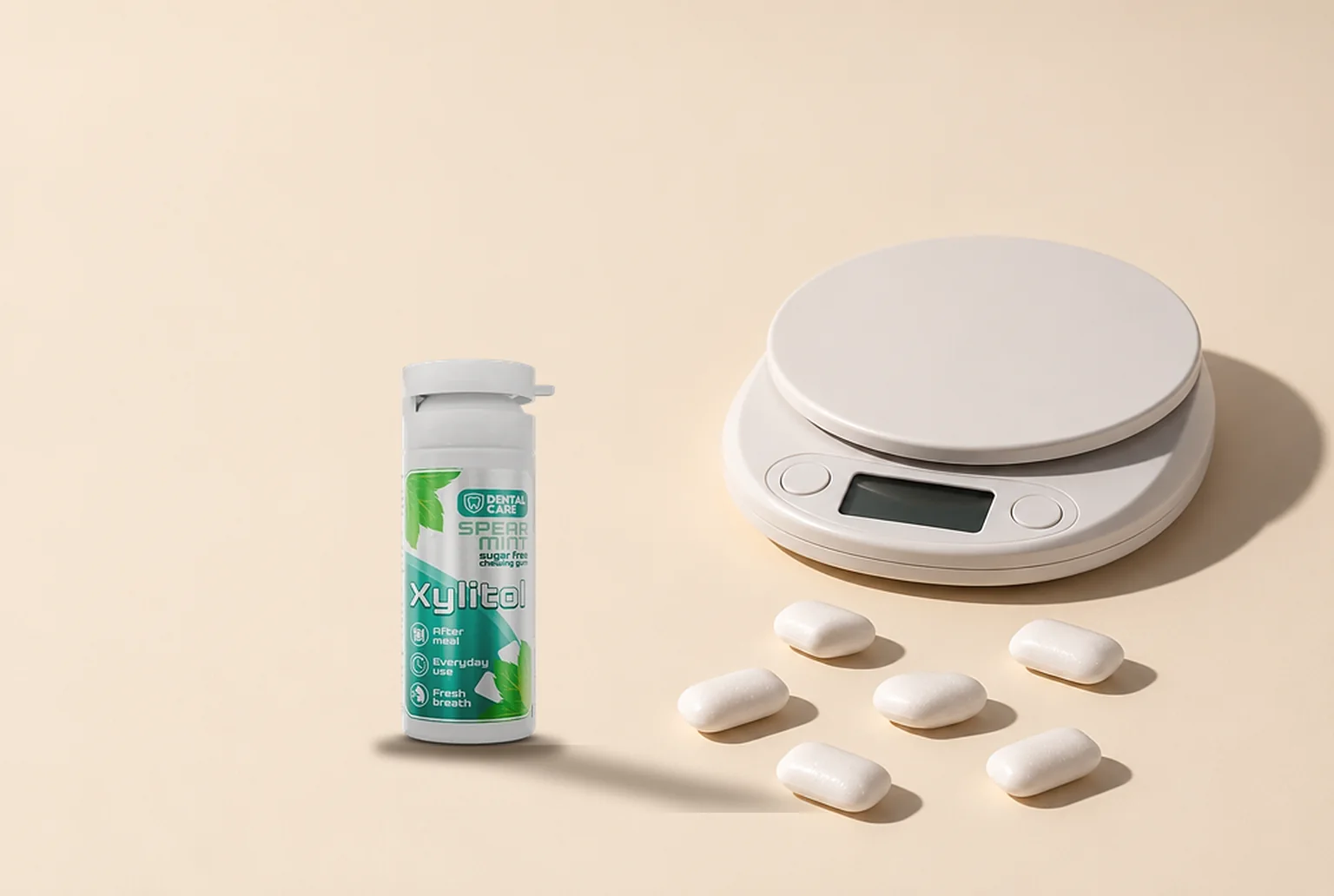
- Dental Care Xylitol gum: sweetened only with xylitol, with roughly 0.7 to 1.2 g per pellet. The calculator uses 1.2 g.
- Known amount per piece: if the label gives xylitol per piece, or per 100 g together with the piece weight, you can enter the exact figure.
- Pure xylitol sweetener: one level teaspoon of granulated xylitol weighs roughly 4 g. A heaped spoon or a spill from a bag can hold much more, so grams are more reliable if you can weigh what is left.
If you are unsure how many pieces are missing, count what remains in the pack and assume the rest was eaten. Wrappers on the floor do not prove the gum went with them, but an empty pack should be treated as an empty pack.
My dog ate gum: what to do right now
The first 30 minutes matter most, because a vet has more options before xylitol is fully absorbed. Work through these steps in order.
1. Stop further eating and secure the product
Take away whatever is left, including wrappers, the pack and anything else in the bag or pocket the dog raided. Keep the packaging. The ingredient list, the brand and the number of pieces left are exactly what your vet will ask for.
2. Work out the numbers
You need three facts: your dog’s approximate weight, what was eaten and how much, and roughly when it happened. Put them into the calculator above. If you have no idea of the weight, a reasonable guess is fine. Speed matters more than precision.
3. Call your vet or an animal poison line
Call even if the calculator shows the lowest band and even if your dog seems completely normal. Signs of low blood sugar can start within 30 to 60 minutes, and liver damage can follow over the next day or two in dogs that looked well at first. Tell the vet the product name, the estimated amount, the time and your dog’s weight. In the UK, the Animal PoisonLine (01202 509000) gives advice to owners for a fee. Elsewhere in Europe, your own vet or the nearest emergency clinic is the right first call.
4. Do not make your dog vomit unless a vet tells you to
Inducing vomiting can help if it happens early and under veterinary guidance, but home methods can cause harm. Salt can cause dangerous sodium levels, and hydrogen peroxide can irritate or injure the stomach. A dog whose blood sugar is already falling may also be weak or unsteady, which makes vomiting risky. Leave this decision to the vet.
5. Watch for warning signs on the way
Early signs of low blood sugar include vomiting, weakness, wobbliness, lethargy, collapse, trembling and seizures. If your vet advises it, rubbing a little honey or syrup onto the gums can help a dog with signs of hypoglycaemia on the way to the clinic. Do not try to pour liquid into the mouth of a dog that is drowsy or seizing.
6. Go to the clinic if advised, and take the pack
Most dogs that eat a meaningful amount of xylitol need blood tests and monitoring, even if they feel fine. Bring the packaging and the calculator result. A short written note of times and amounts saves minutes at the reception desk.
What happens at the vet
Treatment depends on the dose, the time since ingestion and how the dog is doing on arrival. The general approach described in veterinary reviews looks like this (Murphy and Coleman, 2012; Murphy and Dunayer, 2018; Schmid and Hovda, 2016):
- Decontamination: if the dog is alert and the ingestion was recent, the vet may induce vomiting with a veterinary medicine to remove gum still in the stomach.
- Blood glucose checks: blood sugar is measured on arrival and repeated over the following hours, because it often keeps falling after the dog reaches the clinic.
- Glucose support: dogs with low or falling blood sugar receive dextrose, often as a drip, and frequent small meals once they can eat.
- Liver monitoring: at higher doses, liver enzymes and clotting are checked over the next 24 to 72 hours, and liver-supporting medicines such as N-acetylcysteine or SAMe may be started.
The outlook is encouraging when treatment starts early. In a review of 192 dogs seen at three university hospitals after eating xylitol, all survived to discharge. Only one in five had signs on arrival, yet blood sugar fell after presentation in most dogs, which is why the authors recommend hospital monitoring even for dogs that look well. They described the prognosis as excellent for dogs that ate lower doses and did not develop liver failure (DuHadway et al., 2015). The outlook is more guarded once acute liver failure develops: in an earlier series of eight dogs with liver failure, five died or were euthanised (Dunayer and Gwaltney-Brant, 2006).
Worked examples
These examples show how quickly the numbers add up. They use the calculator’s cautious assumptions.
| Dog | What was eaten | Estimated xylitol | Dose | Band |
|---|---|---|---|---|
| Chihuahua, 3 kg | 1 piece of unknown sugar-free gum | 1.0 g | 0.33 g/kg | Low blood sugar risk |
| Cocker spaniel, 12 kg | 2 pellets of Dental Care Xylitol | 2.4 g | 0.2 g/kg | Low blood sugar risk |
| Beagle, 10 kg | Half a 20-pellet tube of Dental Care Xylitol | 12 g | 1.2 g/kg | Liver failure risk |
| Labrador, 32 kg | 1 breath mint | 1.0 g | 0.03 g/kg | Below thresholds, still call |
| Border collie, 18 kg | 1 level teaspoon of xylitol sweetener | about 4 g | 0.22 g/kg | Low blood sugar risk |
Two patterns stand out. Small dogs reach dangerous doses with very little product, and pure xylitol sweetener is far more concentrated than gum. A tablespoon spilled on the kitchen floor can contain enough xylitol to reach the liver-failure band in a medium-sized dog.
How much xylitol is in common products?
Xylitol appears in far more than chewing gum. The amounts below are typical ranges or rough guides. Always check the label of the product your dog actually ate.
| Product | Typical xylitol content | Notes |
|---|---|---|
| Sugar-free chewing gum | 0.22 to 1.0 g per piece | Many brands list xylitol without the amount per piece. |
| Dental Care Xylitol gum | About 0.7 to 1.2 g per pellet | 100% xylitol as sweetener. 20 pellets per tube. |
| Breath mints | Up to about 1 g per mint | Small size makes them easy to swallow in quantity. |
| Granulated xylitol sweetener | About 4 g per level teaspoon | The most concentrated form found at home. |
| Sugar-free sweets and chocolate | Varies widely | Check the ingredients for xylitol or E967. |
| Nut butters, baked goods, jams | Varies widely | Some sugar-free or low-carb versions contain xylitol. |
| Toothpaste, mouthwash, chewable vitamins | Usually small, varies | Never use human toothpaste on dogs. |
On ingredient lists, xylitol may also appear as E967, birch sugar or wood sugar. If a product your dog ate is labelled sugar-free and you cannot find the sweetener, assume xylitol until you know otherwise.
Why the calculator can underestimate risk
A calculator is useful because it turns panic into numbers. It also has limits that every owner should understand:
- The amount eaten is usually a guess. Dogs rarely leave evidence of exactly how many pieces they swallowed.
- Product content varies. Two packs that look similar can contain very different amounts of xylitol per piece.
- Individual sensitivity varies. The published thresholds describe typical responses, not every dog. Liver injury has been reported in dogs that never became hypoglycaemic.
- Timing is uncertain. Signs often appear within an hour, but in a large case series blood sugar kept falling after dogs reached the clinic, so a normal first hour does not mean the danger has passed.
- Other ingredients matter. Some products combine xylitol with chocolate, caffeine, raisins or medicines that carry their own risks.
For these reasons the calculator never shows a safe result. The lowest band reads below published thresholds, which is a statement about the estimate, not about your dog.
Preventing xylitol poisoning
Most xylitol cases in dogs are accidents: a handbag left on the floor, a pack of gum in a coat pocket, a guest who does not know the dog will help itself. A few habits remove most of the risk:
- Keep gum, mints and xylitol sweetener in closed cupboards or high shelves, not in open bowls or low drawers.
- Hang bags and coats out of reach, and ask visitors to do the same.
- Close the tube or pack after every use. A secure lid slows a curious dog down, but it is not dog-proof.
- Store xylitol sweetener in a sealed container and wipe up spills straight away.
- Use only dog toothpaste for your dog, and check the labels of nut butters before using them for treats or medicine.
- Tell children and house-sitters that sugar-free sweets are dangerous for the dog.
We include a dog warning on every tube of Dental Care Xylitol for exactly this reason. Xylitol supports oral hygiene in people, and the same ingredient is dangerous for dogs. Both facts are true at once, and responsible use means keeping the product where only people can reach it.
Other pets
Dogs are the species most at risk. In a study in cats, xylitol at doses that would be dangerous for dogs did not cause hypoglycaemia or liver damage (Jerzsele et al., 2018), and cats rarely eat sweet foods anyway. Ferrets, however, have been reported to develop low blood sugar and seizures after eating xylitol, according to the US Food and Drug Administration. If any pet other than a dog eats a xylitol product, call your vet for advice specific to that species.
For a fuller explanation of why dogs react so strongly, including the insulin mechanism, the symptoms in detail and common myths, read our xylitol and dogs guide. For the human side of the story, including the evidence on teeth and the EU-authorised health claims, see our guide to what xylitol is and how it works in people.
Frequently asked questions
How much xylitol is toxic to a dog?
Veterinary references link more than 0.1 g of xylitol per kg of body weight with a risk of dangerous low blood sugar, and more than 0.5 g per kg with a risk of acute liver failure. Some poison centres recommend treatment from 0.05 g per kg.
How many pieces of gum can kill a dog?
There is no safe number. One piece of sugar-free gum can contain up to about 1 g of xylitol, which is enough to reach the hypoglycaemia threshold in a dog of around 10 kg. Small dogs can be affected by a single piece. Contact a vet after any ingestion.
My dog ate one piece of gum. Should I worry?
Call your vet. For a large dog, one piece may fall below published thresholds, but the xylitol content of gum varies and the amount eaten is often uncertain. For small dogs, one piece can be enough to cause low blood sugar.
How long after eating xylitol will a dog show symptoms?
Signs of low blood sugar often appear within 30 to 60 minutes, but blood sugar can keep falling for hours, so vets usually monitor dogs even when they look well. Liver damage can develop over one to three days, even in dogs that seemed fine at first.
Should I make my dog vomit after eating gum?
Only if a vet tells you to. Home methods such as salt or hydrogen peroxide can cause harm, and a dog with falling blood sugar may be too weak to vomit safely. Vets use veterinary medicines to induce vomiting when it is appropriate.
Is the xylitol dog calculator accurate?
It is a rough estimate. It uses published veterinary thresholds and cautious assumptions about xylitol content, but it cannot know exactly how much your dog ate or how your individual dog will react. It is not a diagnosis.
What if the gum label does not say how much xylitol it contains?
Choose the unknown gum option in the calculator. It assumes 1 g per piece, the top of the usual 0.22 to 1.0 g range for gum and mints, so the estimate errs on the side of caution.
Is xylitol dangerous for cats?
Cats do not appear to react to xylitol the way dogs do. In a study in cats, doses that would be dangerous for dogs did not cause low blood sugar or liver damage. Ask your vet if any pet other than a dog eats a xylitol product.
Sources
- Piscitelli CM, Dunayer EK, Aumann M. Xylitol toxicity in dogs. Compend Contin Educ Vet. 2010. PubMed 20473849
- Murphy LA, Coleman AE. Xylitol toxicosis in dogs. Vet Clin North Am Small Anim Pract. 2012. doi.org/10.1016/j.cvsm.2011.12.003
- Murphy LA, Dunayer EK. Xylitol toxicosis in dogs: an update. Vet Clin North Am Small Anim Pract. 2018. doi.org/10.1016/j.cvsm.2018.06.004
- Dunayer EK, Gwaltney-Brant SM. Acute hepatic failure and coagulopathy associated with xylitol ingestion in eight dogs. J Am Vet Med Assoc. 2006. doi.org/10.2460/javma.229.7.1113
- DuHadway MR, et al. Retrospective evaluation of xylitol ingestion in dogs: 192 cases (2007 to 2012). J Vet Emerg Crit Care. 2015. doi.org/10.1111/vec.12350
- Schmid RD, Hovda LR. Acute hepatic failure in a dog after xylitol ingestion. J Med Toxicol. 2016. doi.org/10.1007/s13181-015-0531-7
- Jerzsele Á, et al. Effects of p.o. administered xylitol in cats. J Vet Pharmacol Ther. 2018. doi.org/10.1111/jvp.12479
- Tox Info Suisse. Xylitol warning: danger to dogs. toxinfo.ch
- US Food and Drug Administration. Paws off xylitol; it’s dangerous for dogs. fda.gov
- Pet Poison Helpline. Is xylitol poisonous to dogs? petpoisonhelpline.com
- Animal PoisonLine (UK). animalpoisonline.co.uk
This calculator and article are for general information. They do not replace advice from a veterinarian. If your dog has eaten xylitol, contact a vet immediately. Scientific sources were retrieved from PubMed and checked on 24 November 2026.