Key takeaways
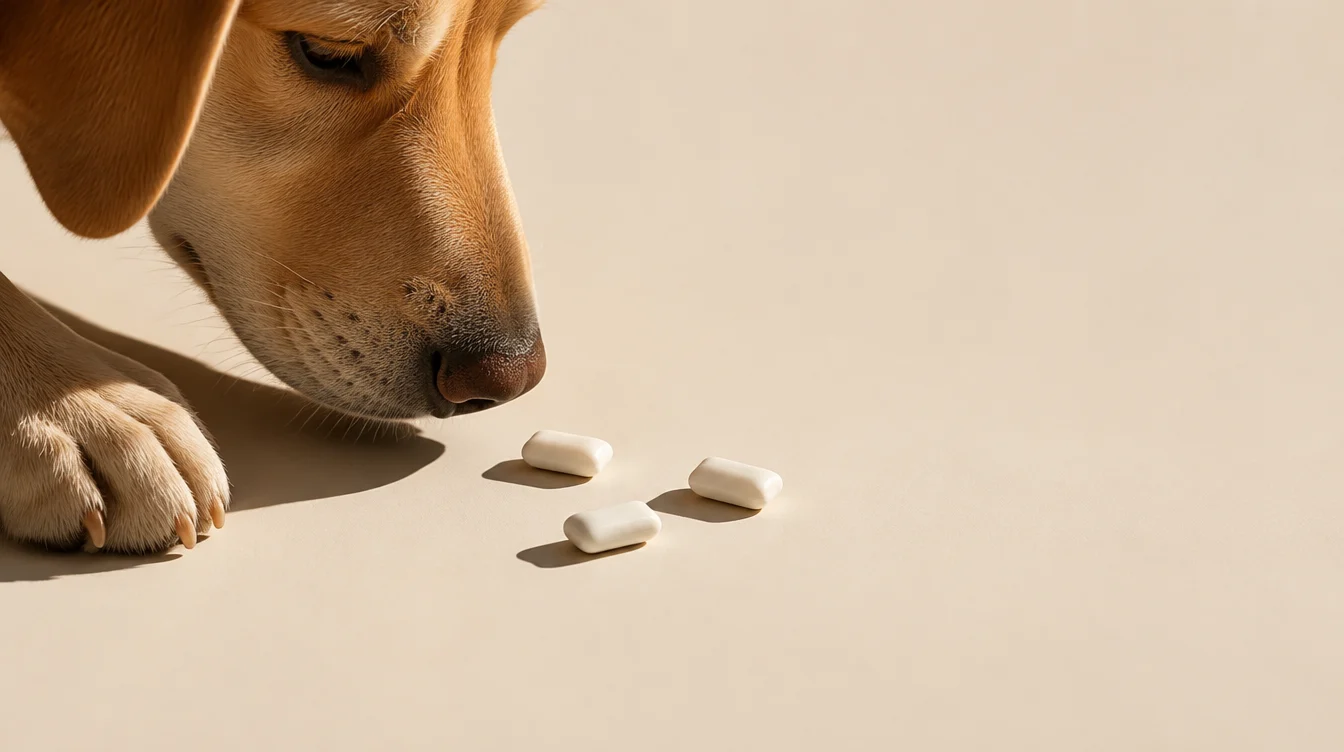
- Xylitol is safe for people but highly toxic to dogs. In dogs it triggers a rapid release of insulin that can cause dangerously low blood sugar, and at higher doses acute liver failure.
- Veterinary references put the risk of hypoglycaemia at more than 0.1 g of xylitol per kg of body weight, and the risk of liver failure at more than 0.5 g per kg.
- A single piece of xylitol gum can contain around 1 g of xylitol, so even a few pieces can be dangerous for a small or medium-sized dog.
- Signs can appear within 20 to 60 minutes: vomiting, weakness, wobbliness, collapse or seizures. Liver damage can follow within a day or two, even in dogs that seemed fine.
- If your dog has eaten anything containing xylitol, call a vet or an animal poison line straight away. Do not wait for symptoms and do not make your dog vomit unless a vet tells you to.
- Dogs treated quickly, before liver damage develops, usually recover well.
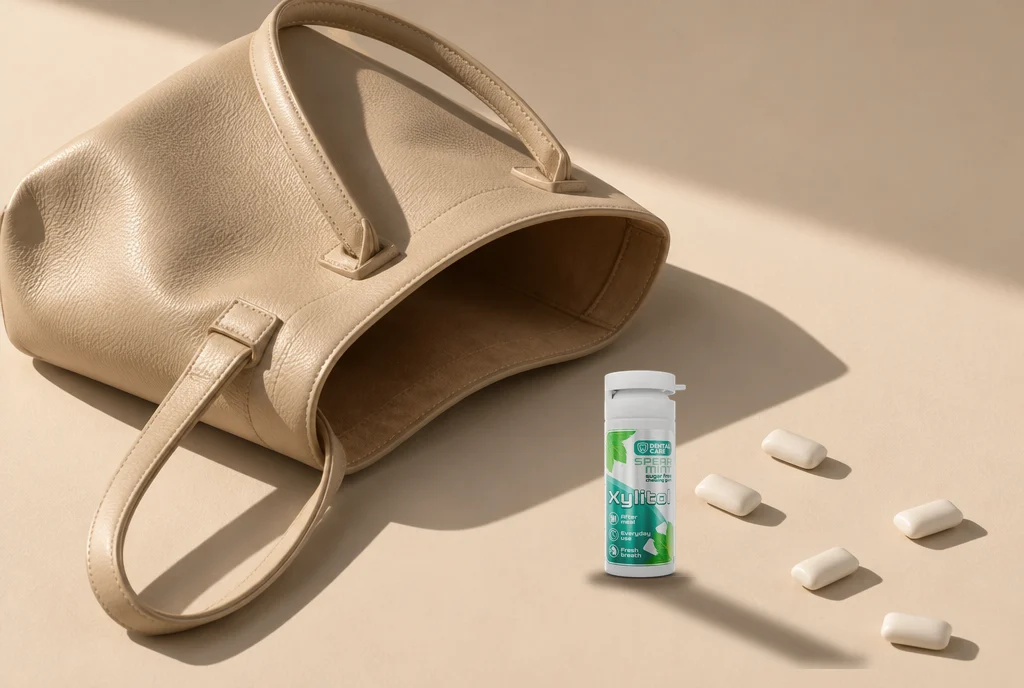
Most dog owners know about chocolate, grapes and onions. Far fewer know about xylitol, the sweetener in many sugar-free gums, mints and toothpastes. For people, xylitol is a well-studied sugar substitute. For dogs, it is one of the most dangerous things in the house, and a dropped packet of gum or an open handbag on the floor can be enough to cause a veterinary emergency.
As a company that makes xylitol chewing gum, we think we have a particular responsibility to explain this clearly. This guide covers why xylitol is toxic to dogs, how much is dangerous, the symptoms to watch for, what treatment involves, which everyday products contain xylitol and how to keep your dog safe. Every key fact links to veterinary research or official guidance. It is general information, not a substitute for your vet.
Is xylitol toxic to dogs?
Yes. Xylitol is toxic to dogs, and the effects can be severe or fatal. A review in the veterinary journal Compendium describes xylitol as harmless to people but known to cause life-threatening toxicoses in dogs (Piscitelli et al., 2010). The US Food and Drug Administration has warned dog owners about xylitol in a consumer update, noting that many of the poisoning reports it received involved chewing gum.
The danger is not a mild stomach upset. Xylitol can cause two separate problems in dogs: hypoglycaemia (a sudden, dangerous drop in blood sugar) and, at higher doses, acute liver failure, sometimes with bleeding problems. Both need urgent veterinary care.
Why is xylitol dangerous for dogs but not for people?
The difference lies in how the pancreas responds. In people, xylitol is absorbed slowly and causes very little insulin release, which is why it is used as a low-glycaemic sugar substitute. If you want the background, our guide explains what xylitol is and how it works.
In dogs, xylitol is absorbed quickly and is believed to stimulate an excessive release of insulin from the pancreas. Insulin pushes glucose out of the blood and into cells, so blood sugar can fall sharply within minutes to an hour. A review in Veterinary Clinics of North America describes this sequence: severe hypoglycaemia, potentially followed by acute hepatic failure and clotting problems (Murphy and Coleman, 2012).
Why xylitol damages the liver is still not fully understood. Researchers have proposed several mechanisms, including, in one early laboratory study, an immune-mediated reaction (Imai et al., 2012). What matters for owners is that liver damage can develop even when a dog’s blood sugar has been corrected, which is why vets monitor liver values for a day or more after a significant exposure.
How much xylitol is toxic to dogs?
Veterinary references give two commonly used thresholds, based on grams of xylitol per kilogram of the dog’s body weight (Piscitelli et al., 2010):
- More than 0.1 g per kg: risk of hypoglycaemia.
- More than 0.5 g per kg: risk of acute liver failure.
Some sources report life-threatening effects at doses as low as 0.15 g per kg (Eapen et al., 2017). These numbers are reference points for vets, not safe limits. Individual dogs react differently, and you usually cannot know exactly how much xylitol your dog ate.
What this means in pieces of gum
Xylitol content varies a lot between products. Gum sweetened only with xylitol, such as our Dental Care Xylitol, contains about 1 g of xylitol per piece. Here is what the reference thresholds look like for gum with 1 g of xylitol per piece:
| Dog’s weight | Hypoglycaemia risk from | Liver failure risk from |
|---|---|---|
| 5 kg (for example, a Chihuahua) | Half a piece (0.5 g) | 2 to 3 pieces (2.5 g) |
| 10 kg (for example, a Beagle puppy or Jack Russell) | 1 piece (1 g) | 5 pieces (5 g) |
| 20 kg (for example, a Border Collie) | 2 pieces (2 g) | 10 pieces (10 g) |
| 30 kg (for example, a Labrador) | 3 pieces (3 g) | 15 pieces (15 g) |
| 40 kg (for example, a German Shepherd) | 4 pieces (4 g) | 20 pieces, one full pack (20 g) |
In other words, a single pack of 100% xylitol gum can contain enough xylitol to put a large dog at risk of liver failure, and one or two pieces can cause low blood sugar in a small dog. Products sweetened with a blend of sweeteners usually contain less xylitol per piece, but often do not state the amount, so they should be treated as dangerous too.
To work out the dose for your own dog, use our xylitol dog calculator. Enter your dog’s weight and what was eaten, and it estimates the dose in g/kg and shows the matching risk band.
Pure xylitol sweetener, sold as a sugar replacement for baking, is the most concentrated source. In one published case, a 4.95 kg Chihuahua ate 224 g of granulated xylitol (about 45 g per kg). It developed hypoglycaemia within one to two hours, signs of liver failure within twelve hours and a clotting disorder within a day, and survived only with intensive treatment (Schmid and Hovda, 2016).
Symptoms of xylitol poisoning in dogs
Signs depend on the dose and on how quickly the xylitol is absorbed. The FDA warns that poisoning can start within about 20 minutes, while signs of liver damage may take longer to appear.
Early signs: low blood sugar (minutes to a few hours)
- Vomiting
- Weakness, lethargy or unusual quietness
- Wobbliness, stumbling or difficulty standing
- Trembling or muscle twitching
- Collapse
- Seizures
In a review of 192 dogs seen at three university hospitals after eating xylitol, only 20% had signs when they arrived. The most common sign was vomiting, followed by lethargy, and dogs with signs had eaten significantly larger doses. Thirty dogs developed low blood sugar at some point during hospital monitoring, which is why vets keep watching even dogs that look well (DuHadway et al., 2015).
Later signs: liver damage (hours to days)
- Continued lethargy and loss of appetite
- Vomiting, sometimes with blood
- Yellowing of the gums, skin or whites of the eyes (jaundice)
- Small red or purple spots on the gums or skin, bruising, or blood in the stool (signs of a clotting problem)
- Abdominal discomfort
In the first published series of liver failure cases, eight dogs were treated for lethargy and vomiting after eating xylitol. Five of them had widespread bleeding, and blood tests showed high liver enzymes, low blood sugar, prolonged clotting times and low platelet counts. Of the eight dogs, two recovered completely, one was recovering when lost to follow-up, and five died or were euthanised (Dunayer and Gwaltney-Brant, 2006).
Do not wait for symptoms. A dog that looks completely normal shortly after eating xylitol can still develop hypoglycaemia or liver damage later.
What to do if your dog ate xylitol

Treat it as an emergency, even if your dog seems fine. Quick action gives your vet the best chance to prevent serious problems.
- Call your vet or emergency vet immediately. In the UK, you can also call the Animal PoisonLine on 01202 509000, a 24-hour triage service for pet owners run by the Veterinary Poisons Information Service. In other countries, contact your local emergency vet or national animal poison service.
- Gather the facts. Note what your dog ate, the brand, how many pieces or how many grams, the xylitol content if it is printed on the pack, roughly when it happened and your dog’s weight. Take the packaging with you.
- Do not make your dog vomit at home unless a vet tells you to. Home methods can be ineffective or harmful, and a vet will decide whether inducing vomiting is safe and useful.
- Do not give food or sugar as a substitute for treatment. A vet may advise offering something sweet on the way to the clinic if your dog is weak, but only follow that advice if they give it.
- Go to the clinic if advised, and keep your dog calm and warm on the way.
How vets treat xylitol poisoning
Treatment depends on how much xylitol was eaten, how long ago and whether your dog already has symptoms. It commonly includes:
- Decontamination: if the ingestion was recent and the dog has no symptoms, a vet may induce vomiting to remove gum or sweetener from the stomach.
- Blood sugar monitoring: repeated glucose checks during hospital monitoring, because blood sugar drops in most dogs after they arrive at the clinic (DuHadway et al., 2015).
- Glucose support: intravenous dextrose to correct and prevent hypoglycaemia.
- Liver monitoring and support: repeated liver blood tests, often over the following days, and medicines that support the liver if values rise. In the Chihuahua case above, treatment included N-acetylcysteine and S-adenosylmethionine (Schmid and Hovda, 2016).
- Treatment of bleeding problems: vitamin K or plasma transfusions if clotting is affected.
Prognosis
The outlook is generally good for dogs that receive prompt care and do not develop liver failure. In the review of 192 cases, all dogs survived to discharge, and the authors described the prognosis for dogs that ingest lower doses and do not develop liver failure as excellent (DuHadway et al., 2015). For dogs with severe liver damage, the prognosis is guarded to poor (Piscitelli et al., 2010). This is exactly why early treatment matters so much.
Which products contain xylitol?
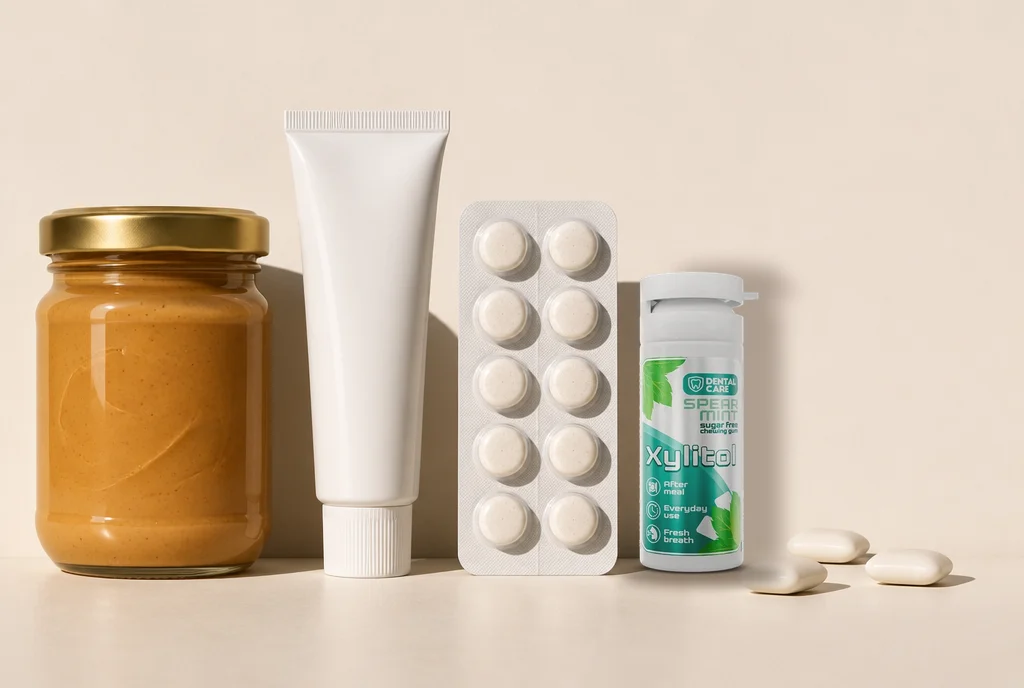
Many of the poisoning reports received by the FDA involved chewing gum, but gum is far from the only source. The FDA lists products ranging from mints and baked goods to toothpaste, mouthwash, chewable vitamins and some nut butters. Check the label on anything sweet or “sugar-free” that a dog could reach, including:
- Sugar-free chewing gum and breath mints
- Pure xylitol sweetener for baking and hot drinks, sometimes sold as “birch sugar”
- Some peanut butters and nut butters, a particular risk because owners often use them to give tablets
- Sugar-free sweets, chocolate, jams, desserts and baked goods
- Toothpaste and mouthwash for people
- Chewable vitamins, supplements and some liquid or chewable medicines
- Some nicotine gums and lozenges
- Some nasal sprays and cosmetic products
On ingredient lists, xylitol may appear as xylitol, E 967, birch sugar or wood sugar. If a product says “sugar-free” and you are not sure what sweetens it, keep it away from your dog.
Do not assume that chewed gum is harmless. Researchers have developed laboratory methods to measure xylitol in partly chewed gum precisely because it is unclear how much remains and how dangerous it still is for dogs (Rajapaksha et al., 2019). Put used gum in a closed bin.
How to keep your dog safe
- Keep bags off the floor. Handbags, school bags, gym bags and jacket pockets are where many dogs find gum. Hang them up or close them in a cupboard, and ask guests to do the same.
- Store xylitol products up high or behind closed doors. Treat gum, mints and xylitol sweetener like medicines.
- Check every peanut butter you use for your dog. Use a brand you have checked, and consider keeping a separate, clearly labelled jar for the dog.
- Use pet toothpaste only. Never brush a dog’s teeth with human toothpaste.
- Teach children and visitors not to share sweets, gum or baked goods with the dog.
- Bin used gum in a closed bin, not in a low waste basket or on the ground during walks.
- Save your vet’s and the emergency clinic’s numbers in your phone so you can act in seconds.
On our side, every Dental Care Xylitol pack and product page carries a clear warning that xylitol is harmful to dogs. If you use xylitol gum, the simplest habit is to keep the pack where you would keep a medicine.
Common myths about xylitol and dogs
“A little bit of gum will not hurt”
The amount that matters depends on your dog’s weight and the xylitol content of the product, and both are easy to underestimate. With 100% xylitol gum, a single piece can reach the hypoglycaemia threshold for a dog of around 10 kg. Small dogs and puppies are at the highest risk because they need very little xylitol to reach a dangerous dose.
“My dog vomited, so the gum is out”
Vomiting is itself one of the first signs of poisoning, and it does not mean the xylitol has been removed. Xylitol is absorbed quickly, so some of it may already be in the bloodstream. A dog that vomits after eating xylitol still needs a vet.
“My dog seems fine, so we can wait and see”
In the review of 192 dogs, most had no signs when they arrived at the clinic, yet thirty developed low blood sugar during monitoring and thirty had raised liver values (DuHadway et al., 2015). Waiting for symptoms means losing the time when treatment is simplest and most effective.
“Natural sweeteners are safe for pets”
Xylitol is often marketed as natural or plant-based because it is made from birch or corn fibre. That says nothing about its safety for dogs. “Natural” and “birch sugar” on a label should prompt a closer look, not reassurance.
“Only sweets contain xylitol”
Toothpaste, mouthwash, chewable vitamins, some medicines and some nut butters can contain xylitol too. Some of these, such as toothpaste and medicines, are things owners might give or leave within reach without thinking of them as food.
Caring for your dog’s teeth without xylitol
Xylitol has a place in human oral care, but dogs need their own products. If you want to look after your dog’s teeth, these are safer habits to discuss with your vet:
- Brush with a toothpaste made for dogs. Pet toothpastes are designed to be swallowed safely and come in flavours dogs accept. Never use human toothpaste.
- Build the habit slowly. Start with a finger brush and a few seconds a day, and reward your dog. Regular, gentle brushing is more useful than occasional long sessions.
- Ask about dental chews and diets. Your vet can recommend products suited to your dog’s size, age and dental health, and check the ingredient list for you.
- Book regular dental checks. Vets can spot tartar, gum inflammation and broken teeth early, and recommend professional cleaning when needed.
- Read labels on any “dental” product for pets or people before it goes near your dog, and avoid anything that lists xylitol.
A quick checklist to save
If your dog eats xylitol
- Call your vet, emergency vet or animal poison line now. Do not wait for symptoms.
- Note the product, the amount, the time and your dog’s weight. Bring the packaging.
- Do not make your dog vomit unless a vet tells you to.
- Expect your vet to monitor blood sugar and liver values, even if your dog seems well.
What about cats and other pets?
Cats appear to be far less sensitive to xylitol than dogs. In a small study, six healthy cats given oral xylitol at 100, 500 and 1,000 mg per kg showed no significant changes in blood counts, liver values or blood sugar, apart from a mild rise in glucose within the normal range at the highest dose. The authors concluded that xylitol did not induce toxic effects in cats (Jerzsele et al., 2018).
That study was small, so it is still sensible to keep xylitol products away from cats. The FDA has also said that xylitol may be dangerous for ferrets. If any pet eats a product you are unsure about, call your vet.
Is erythritol or another sweetener safer for dogs?
Toxicity studies suggest that erythritol, another polyol, is far better tolerated by dogs. One study in Beagle dogs reported no adverse effects at doses of more than 5 g per kg per day in repeat-dose studies, contrasting it with xylitol, where doses as low as 0.15 g per kg can be life-threatening (Eapen et al., 2017).
That does not mean human sugar-free foods are suitable for dogs. Many contain several sweeteners, chocolate, raisins or other ingredients that are harmful to them, and labels do not always make the full sweetener mix clear. The safest rule is simple: do not feed dogs human sweets or sugar-free products at all.
Frequently asked questions
Can one piece of xylitol gum hurt a dog?
It can. A piece of 100% xylitol gum can contain about 1 g of xylitol. Veterinary references put the risk of low blood sugar at more than 0.1 g per kg, so one piece may be enough to cause hypoglycaemia in a dog of around 10 kg or less. Call a vet whatever the amount.
How long after eating xylitol will a dog show symptoms?
Signs of low blood sugar can start within about 20 to 60 minutes, and sometimes later. Signs of liver damage can take from several hours to a day or more to appear, so a dog that seems fine can still be at risk.
What are the first signs of xylitol poisoning in dogs?
The most common early signs are vomiting, weakness or lethargy, wobbliness, trembling, collapse and seizures. Later signs of liver damage include jaundice, bruising or small red spots on the gums, and blood in vomit or stool.
Should I make my dog vomit after eating xylitol?
Not unless a vet tells you to. Call a vet or animal poison line immediately. A vet will decide whether inducing vomiting is safe and useful, and will do it in a controlled way.
Can a dog survive xylitol poisoning?
Yes, especially with fast treatment. In a review of 192 dogs, all survived to discharge, and dogs that ate lower doses and did not develop liver failure had an excellent prognosis. Dogs that develop severe liver failure have a much poorer outlook.
Is xylitol toxic to cats?
Cats appear to be much less sensitive. A small study found no toxic effects in cats at doses that are dangerous to dogs. It is still wise to keep xylitol products away from all pets.
Which peanut butter contains xylitol?
Only some peanut and nut butters contain xylitol, usually reduced-sugar or “sugar-free” versions. Always read the ingredient list before giving any nut butter to a dog, and look for xylitol, E 967 or birch sugar.
Is chewed gum still dangerous for dogs?
It may be. How much xylitol remains in gum after chewing is uncertain, so it should not be assumed to be harmless. Dispose of used gum in a closed bin and treat any gum your dog eats as a potential emergency.
Sources
- Murphy LA, Coleman AE. Xylitol toxicosis in dogs. Vet Clin North Am Small Anim Pract. 2012. doi.org/10.1016/j.cvsm.2011.12.003
- Murphy LA, Dunayer EK. Xylitol toxicosis in dogs: an update. Vet Clin North Am Small Anim Pract. 2018. doi.org/10.1016/j.cvsm.2018.06.004
- Dunayer EK, Gwaltney-Brant SM. Acute hepatic failure and coagulopathy associated with xylitol ingestion in eight dogs. J Am Vet Med Assoc. 2006. doi.org/10.2460/javma.229.7.1113
- DuHadway MR, et al. Retrospective evaluation of xylitol ingestion in dogs: 192 cases (2007 to 2012). J Vet Emerg Crit Care. 2015. doi.org/10.1111/vec.12350
- Piscitelli CM, Dunayer EK, Aumann M. Xylitol toxicity in dogs. Compend Contin Educ Vet. 2010. PubMed 20473849
- Schmid RD, Hovda LR. Acute hepatic failure in a dog after xylitol ingestion. J Med Toxicol. 2016. doi.org/10.1007/s13181-015-0531-7
- Eapen AK, et al. Acute and sub-chronic oral toxicity studies of erythritol in Beagle dogs. Food Chem Toxicol. 2017. doi.org/10.1016/j.fct.2017.04.049
- Jerzsele Á, et al. Effects of p.o. administered xylitol in cats. J Vet Pharmacol Ther. 2018. doi.org/10.1111/jvp.12479
- Imai A, et al. Binding affinity of anti-xylitol antibodies to canine hepatic vessels. Vet Immunol Immunopathol. 2012. doi.org/10.1016/j.vetimm.2012.05.016
- Rajapaksha SM, et al. Extraction and analysis of xylitol in sugar-free gum samples by GC-MS with direct aqueous injection. J Anal Methods Chem. 2019. doi.org/10.1155/2019/1690153
- US Food and Drug Administration. Paws off xylitol; it’s dangerous for dogs. Consumer update. fda.gov
- Animal PoisonLine, Veterinary Poisons Information Service (UK). animalpoisonline.co.uk
This article is for general information and does not replace advice from your veterinarian. If you think your pet has eaten xylitol, contact a vet immediately. Scientific sources were retrieved from PubMed and checked on 18 November 2026.